
A meta article announcing the start of a series exploring all topics and issues related to IM!
Practical Ideas for a Changing Profession
Kia ora fellow Information Management professionals, GLAM specialists, researchers and friends! For more than a few years we have all noticed a profound shift taking place. The conversations are moving away from “how do we file this correctly?” toward “how do we make this usable, findable, and secure in a dynamic environment?”. As a consultant, I am constantly asked how these changes will affect organisations, the way they conduct business, and how we can stay a step or two ahead of the curve.
This series, The Future of IM: Practical Ideas for a Changing Profession, explores the shifting boxes of the IM world. I will tackle individual topics and issues with a pragmatic, slightly irreverent lens. I’m not here to write academic papers or sell the next shiny system. I want to talk about what’s working (and what isn’t) in our workplaces, from small councils and public offices to private IM providers trying to keep up with the exponential amount of data, information and records we create every day.
So, Where Are We Headed?
The Data Age is here. While the IM profession has always valued information, over the past three decades data has transformed into a commodity everyone in society creates and manages to certain degrees. Information management, creation, use and reuse is no longer a niche field ruled by tweed coats and dark archival spaces – it pervades every aspect of our lives, growing day by day. It shapes how we learn, connect and are entertained; it influences the way we understand people, businesses and the wider world. Data is now the lifeblood of our digital existence, a vast and ever-expanding network of information that defines modern society. The total volume of data created, captured and replicated each year (the Global Datasphere) continues to grow at an extraordinary pace. Check out the Statista graph below to see the exponential curve we sit on:
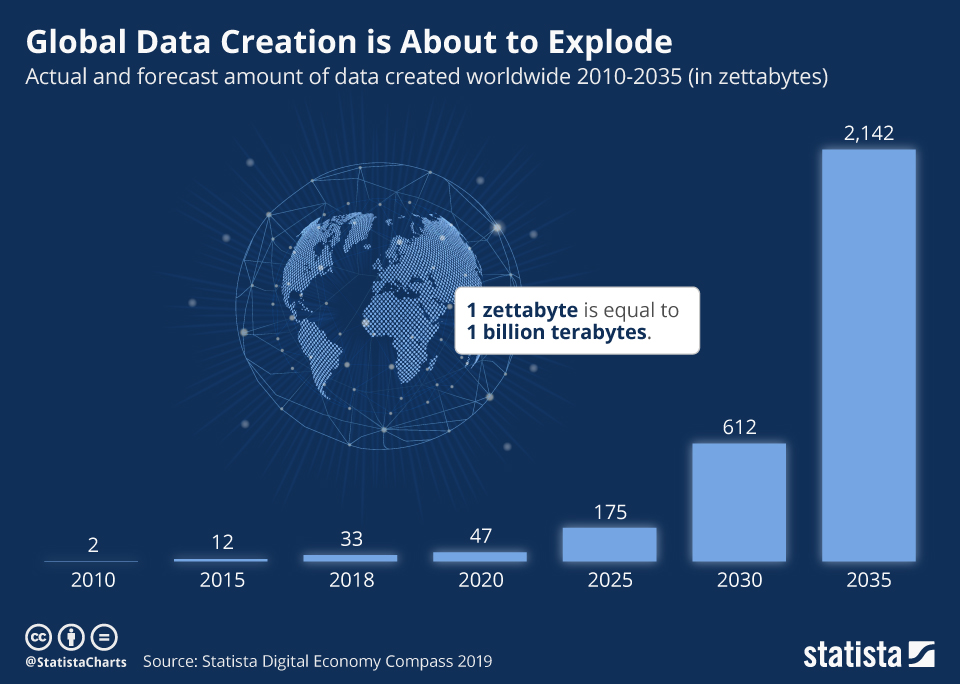
In just the past decade, we’ve moved from an analogue world to a fully digital one, and the possibilities that the next decade holds, powered by data, are virtually limitless. As such, Information Management isn’t vanishing; it’s morphing. The tools, expectations, and behaviours around information are evolving in multiple directions:
- Integrated Ecosystems and Collaboration
The future will belong to organisations that design information to flow between departments, platforms, and councils. The recordkeeper, the archivist, the information technology expert and the GIS analyst are enmeshing, are no longer siloed, but talking the same languages. Teams that can work together towards a common goal will be leaders in the sector. Metadata (and eventually Epidata), automation and taxonomy will do even more heavy lifting. - Creating Practical Policy
Long, unread policies are the enemy. Expect to see a rise in visual, workflow-based guidance, useable retention schedules and automated sentencing, interactive procedures and quick-reference aids embedded directly into the systems staff use every day. - Automation and Intelligence
Machine learning, AI, and auto-classification aren’t just buzzwords. These are great tools we need to add to our IM tool box to tackle repetitive, low-value work. This frees us humans up to put our brain power to use on strategy and holistic thinking. The future of IM as a professional sector lies in governance, oversight, and framework design, not data entry. - Human-Centric IM
The next frontier isn’t more software and focusing on the New New Thing, it’s increasing our skills in what we do everyday – communication and collaboration with colleagues and peers. The IM professional of the future will be part educator, part designer, part strategist, an embracer of change, and fearless of where our digital future is taking us.
The Big Issues
During this series I’ll be unpacking the themes that are shaping the future of our profession. I’ll also be asking IM sector leaders that have topic-specific experience and knowledge to co-author with me.
We’ll begin with the new Information Management Maturity Assessment (IMMA) recently released by Archives New Zealand. This framework is designed to help organisations see where they currently stand, what’s working, what’s not, and where to focus limited resources and capabilities. I’ll share tricks and tips on how to get the most bang for your buck from the process, and maybe even a template or two.
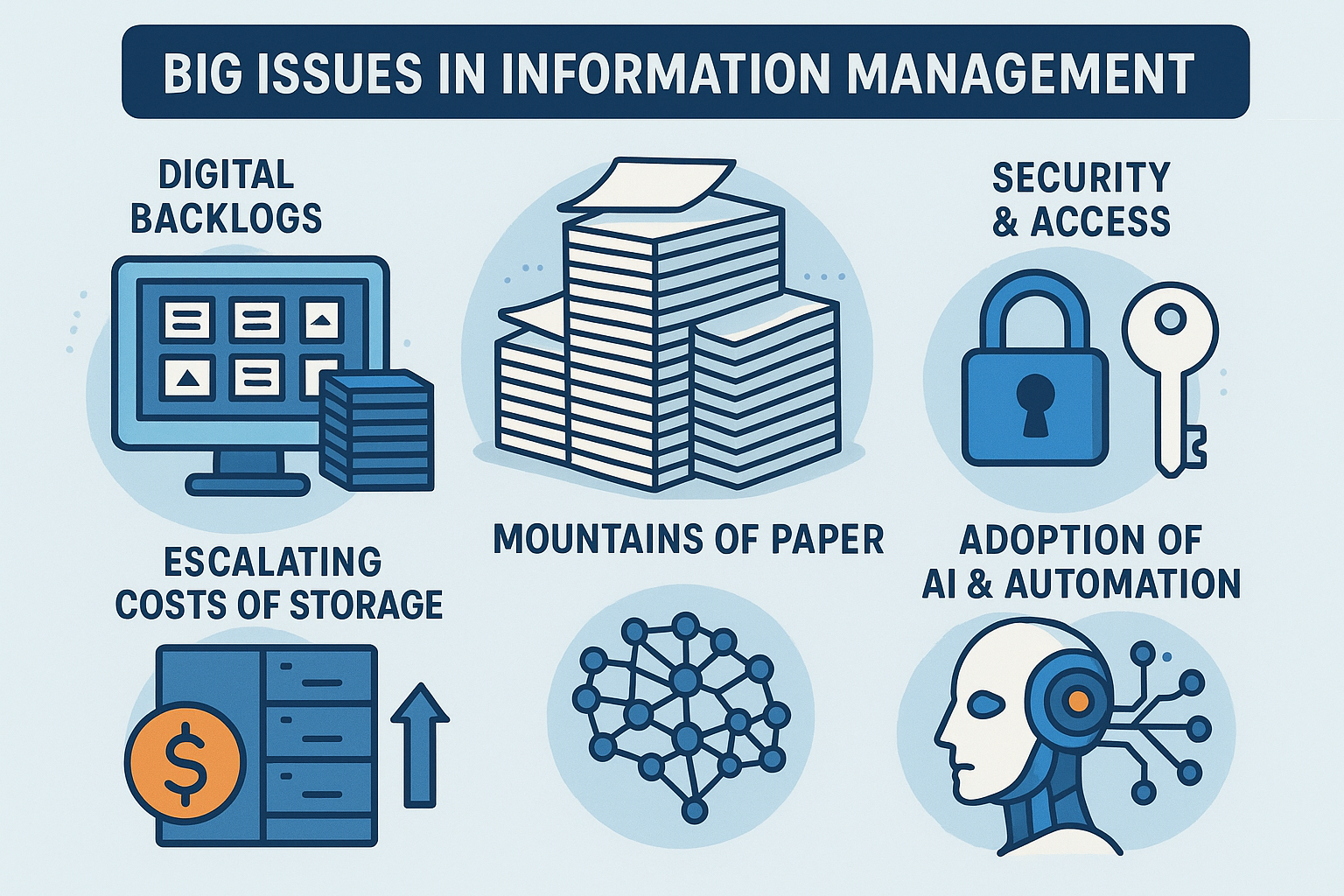
From there, we’ll confront the growing costs of storage, both digital and physical, and the financial realities that come with holding too much for too long. Running beside costs are the familiar but stubborn backlog of physical records. It’s a timely reminder that shelving records on dusty shelves or in third-party storage providers warehouse is not a permanent solution and that if you want to get the most out of your AI, you need to complete the basics first.
As we move deeper into the datasphere we’ll examine the relationship between IM and IT, the ever-blurring space where technology meets governance. The idea of being a Digital First organisation will also take centre stage, where the IM and IT teams work seamlessly together to create and implement innovative solutions, increase efficiency and make staff members lives that much easier.
The conversation will expand into the horizon of innovation and the hottest of topics in the IM space: AI, automation, and analytics. These are tools that promise efficiency, but demand ethical frameworks, with plenty of human oversight and intervention. This naturally leads into questions of access, classification security, privacy, and compliance, where public trust and organisational accountability are on the line. We’ll also look at data governance: the hidden architecture of modern decision-making and the current risk of digital landfills. How can we reduce these overflowing mountains into manageable mole hills that work for, rather than against, us?
To round out the series, we’ll explore new data types and platforms, the growing need for staff capability and confidence, and the global initiatives already influencing how information is managed here in Aotearoa | New Zealand.
Practical Tools and Try-It-Yourself Resources
Each article in this series will be paired with a template you can use, a platform to try, or a new skill to attempt. We’ll cover topics like:
- How to measure IM maturity (sans jargon)
- Automation that actually saves time (and headaches)
- Ways to save $$$ (and stop the CFO from knocking angrily at your door)
- Designing disposal processes that people will actually follow (so the Chief Archivist doesn’t make angry faces at you)
- Metadata schema that makes documents discoverable
- How to get staff buy-in and upskill your colleagues (which we sometimes see as a Sisyphean Task!)
My goal here isn’t to repeat and hand down theory. It is to share standardised solutions that will help the IM sector and my colleagues. These resources are built from 15 years of experience across the IM sector in technical, team leader and board-level roles. They have local authorities and small organisations, where resources are scarce and good IM relies on creativity more than budget, at top of mind.
A Conversation, Not a Lecture
As a wise manager once quipped to me:
You don’t get into the archives business to become rich!
Information Management professionals are a passionate, resourceful bunch – we love what we do and we use our knowledge to great effect. Every office, archive, and records store I’ve visited has people finding inventive ways to make their systems work with the capability and capacity they have been provided.
I want The Future of IM to capture that truth, to become a place for honest discussion.
What’s working in your environment?
What tools or ideas have failed?
Which long-held “rules” deserve retirement?
What’s the “Next Big Thing” you would create if given the time, resources and budget?
I hope that your feedback and stories will help shape future pieces and, ideally, spark collaborations between colleagues and across regions that move the IM needle far into the positive category.
Why Now?
The IM sector is at a tipping point: The next 5 years will define what IM looks like for the next two decades. Between the takeover by Microsoft 365, increasing pressures of IM Governance, the spread of AI-assisted everything, an increasing need for transparency, access and open data…
The role of IM is strategic
This shift won’t automatically happen. It needs professionals within and adjacent to IM to be willing to look ahead, adapt, and experiment. This series is my way of helping that conversation happen and hopefully provide you with useful links and resources along the way.
Join the Discussion
So, here’s my challenge to you, the reader: Read, comment, share, and challenge the ideas that appear here. Try out the tools, and templates tell me what works and what doesn’t, and help make this profession stronger for the next generation! If you are really interested in writing on a specific issue, get in touch and let’s talk about co-authoring an article!
You can start by subscribing to the series or following along on LinkedIn where I will post new articles. Let’s explore what The Future of IM looks like together.
A Dedication
The recent passing of Stephen Clarke has hit our New Zealand IM community hard. Stephen was an outspoken advocate of everything we do as professionals. He dedicated his time, effort and resources to the creation and updating of standards through the International Organization for Standardization (ISO). It was Stephen’s recent writing on his Substack, From Here to Ontology, that galvanised me to start writing these articles. Stephen had agreed to co-author an article or two with me for the series, but with his passing I will now dedicate the entire series to his legacy.
Stephen, this isn’t goodbye, it’s Tìoraidh an-dràsta – Until we meet again for another dram of scotch in the great gig in the sky.

One response to “The Future of Information Management”
-
[…] This article was written by Evan Greensides as part of the Future of IM series. […]
Leave a Reply