

This article was written by Evan Greensides as part of the Future of IM series.
ABSTRACT
Talking to executives about information management Information Management professionals often know exactly what needs to be done, but executives are more likely to respond to business outcomes than to technical detail. This article argues that IM practitioners should translate their work into language that speaks to risk, cost, compliance, productivity, and strategic value. It distinguishes between strategy and tactics, then outlines practical approaches for gaining executive support: asking better “why” questions, selling ideas with evidence, avoiding detail traps, proving value with tangible results, and building strategic conversations around decisions rather than features. It emphasises the role of IM Champions in helping to carry the message across the organisation. The central message is thus: if IM is framed as a solution to real business problems it becomes easier to fund, easier to prioritise, and much less likely to end up buried in a shared drive somewhere next to “Final_v7_really-final.docx”
How do I talk to executives and win our next IM project?
Senior leaders are not sitting around hoping to hear about metadata schemas, retention classes, or our elegantly crafted IM architecture. These personality types want to know what a project does to risk, cost, compliance, productivity, and the bottom line. I have found the trick is to frame Information Management in terms of business outcomes. Here are a few examples:
- proving efficiency gains for all staff from records automation in M365/Sharepoint;
- reducing physical and digital storage costs via sentencing and disposing of information on time, every time;
- better decision-making by creating highly automated information asset register and business systems catalogue, then linking them;
- lower legal exposure through the flagging of high-value/high-risk records, and implementation of mitigation methods;
- creating a coherent IM/Digital Strategy that can articulate how IM will support the next 3 years of organisational development
A few well-placed (and defensible) positive outcomes can accomplish far more than a 40 slide deck full of technical detail ever will. In fact, the moment you can translate “information governance uplift” into “save money, prevent expensive mistakes,” you are no longer just asking for funding, you are now playing the same game in the same arena.
There is also a hard truth here: the professionals an specialists in our sector are rarely trained to step back and have a holistic look at the organisation, its financial health, and where an IM initiative fits into the wider strategic picture. We have been brought up on a robust diet of theory, mixed with practical implementation of technical requirements and analytical thinking; we excel at the operational detail and minutiae level; the trees are the focus, not the forest. However, we will never get to plant more trees if the forest isn’t first producing seeds for us.
Rule of thumb: if an executive starts asking about file formats and disposal triggers, either you have done an excellent job and piqued their interest; or, they have had a suspiciously strong coffee… ☕
Strategies
I have listed below several strategies you can look to adopt and work on in order to increase your fluency in”Exec’ese”. At its most basic, strategy is simply resource allocation and a master plan of where you want to be. We need to decide not only what to do, but also what we do not want to do, and how we will allocate finite resources for the best possible outcomes. When you strip away the noise, this is what strategy comes down to.
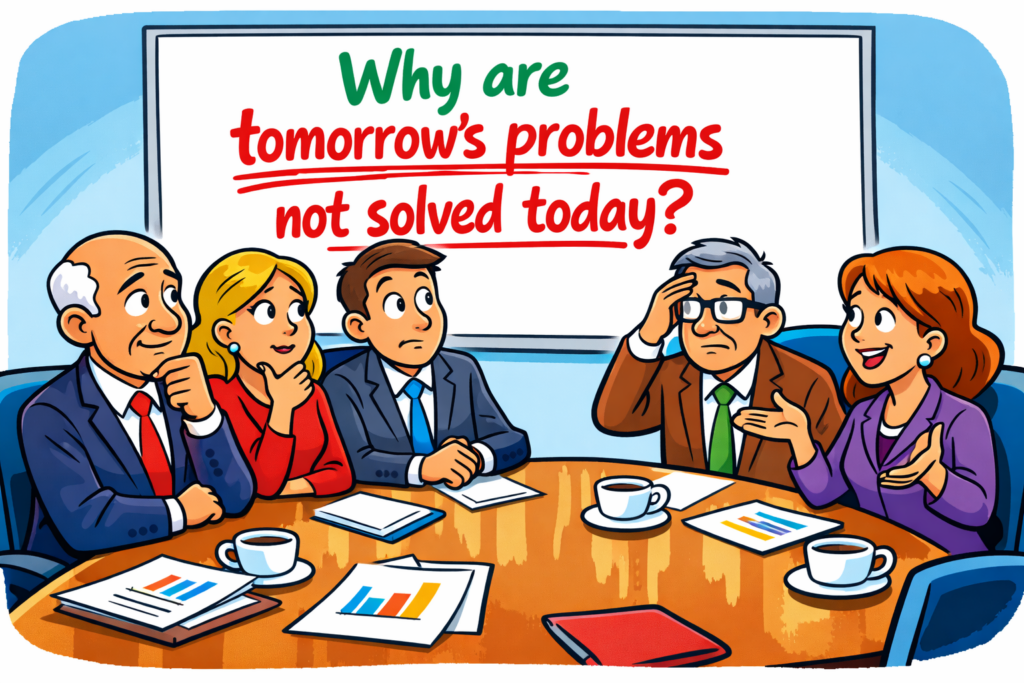
Our First Strategy: Question everything with, “Why?”
Think of a recent project, task or process, major or minor, that succeeded (or better yet, failed!). At the beginning of this undertaking, or at any point through the journey, did you stop and ask:
- “Why are we undertaking this project?”
- “Why should executives continue to invest in IM for the next 3 years?”
- “Why should we prioritise this project over other initiatives that promise similar returns?”
- “Why am I here on this spinning blue ball in the middle of space?” (Just joking, that’s well beyond your pay grade!It’s also already been answered.)
If you can form a list of these types of questions and answer them well, you are on the path to success. If the answers don’t stack when questioned by you and your team, they will not stack up when its time to talk to your managers. If this happens, hit the drawing board again and realign your perspective.
Our Second Strategy: Be able to sell yourself and/or your project
Develop your skills by talking value in plain terms: what it saves, what it fixes, and where things get easier, faster or more efficient. Don’t dance around the value IM can add, even when IM is a secondary team to a project.
An important part of this strategy is articulating credibility. This matters more than energy, so lean on real examples and evidence rather than hype and optimism. If you need to run a test or pilot programme before undertaking a full project, don’t be afraid to say so. Not only will you win points for reducing risk through a staged approach, you will also end up with tangible results from a pilot that will prove your full project is worth resourcing. Executives are not buying your passion project, they’re buying something that won’t blow up their budget or risk profile.
Our Third Strategy: Always add value… in the right language!
Investing in your most valuable assets is always a winner, so it’s importnat we always add value! Make it tangible and visible in how people actually go about completing their jobs. Adding metadata and tags isn’t just an IM “nice to have”, it means people can find what they need without digging through five folders, three email threads, and a shared drive that hasn’t been cleaned since 2012. The same applies to automating retention and disposal. We can reduce the number of awkward “who’s responsible for deleting this?” conversations, or last-minute panic clean-ups before year end.
When things just happen in the background and staff get their time back to do work that actually matters, IM is winning. Even small tweaks, such as consistent file naming, updating a folder structure and re-tuning your Enterprise-wise search can start to show efficiency gains once they are implemented and executives can see the outcomes clearly.
It also pays to to split your value-added thinking between Small Wins and Transformative Initiatives:
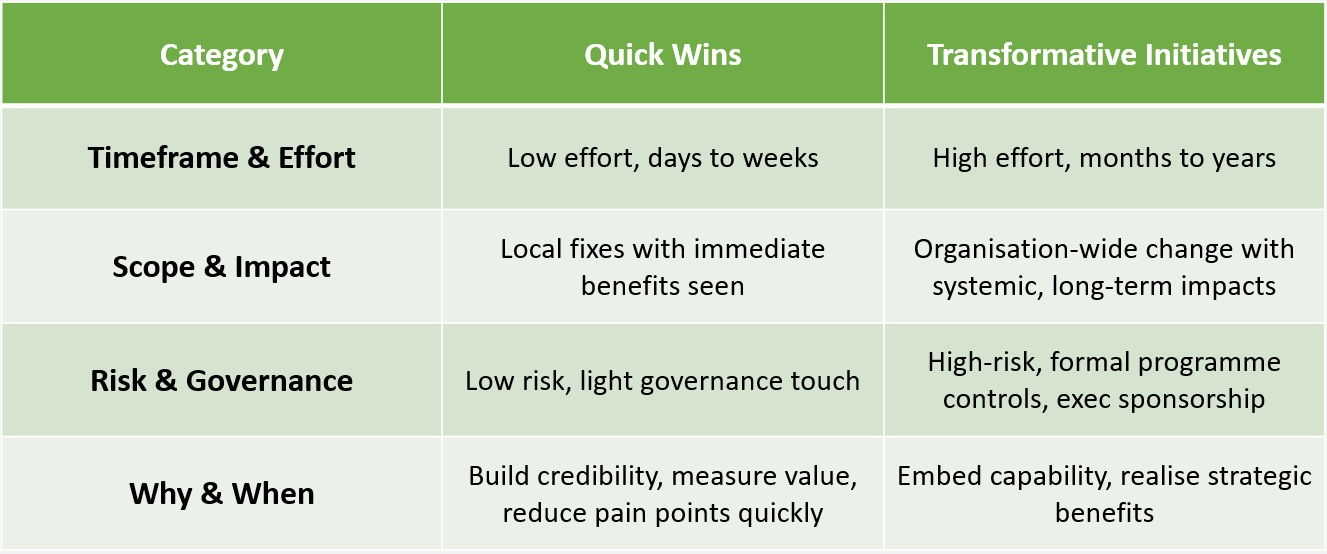
If you are just starting out, whether in a new position at an established organisation or as an emerging IM professional with sole charge, mapping out your strategy, priorities and resources required to accomplish them can pay big dividends. Several small wins and proving the value proposition of IM projects can result in you and your team being better positioned with executives than going for the big win straight off the bat.
The 3 key things executives want to know:
1. “Will this increase revenue and/or efficiencies?”
2. “How does this decrease costs?”
3. “Will this project help to keep me off the front page of the news?”

Tactics we can use
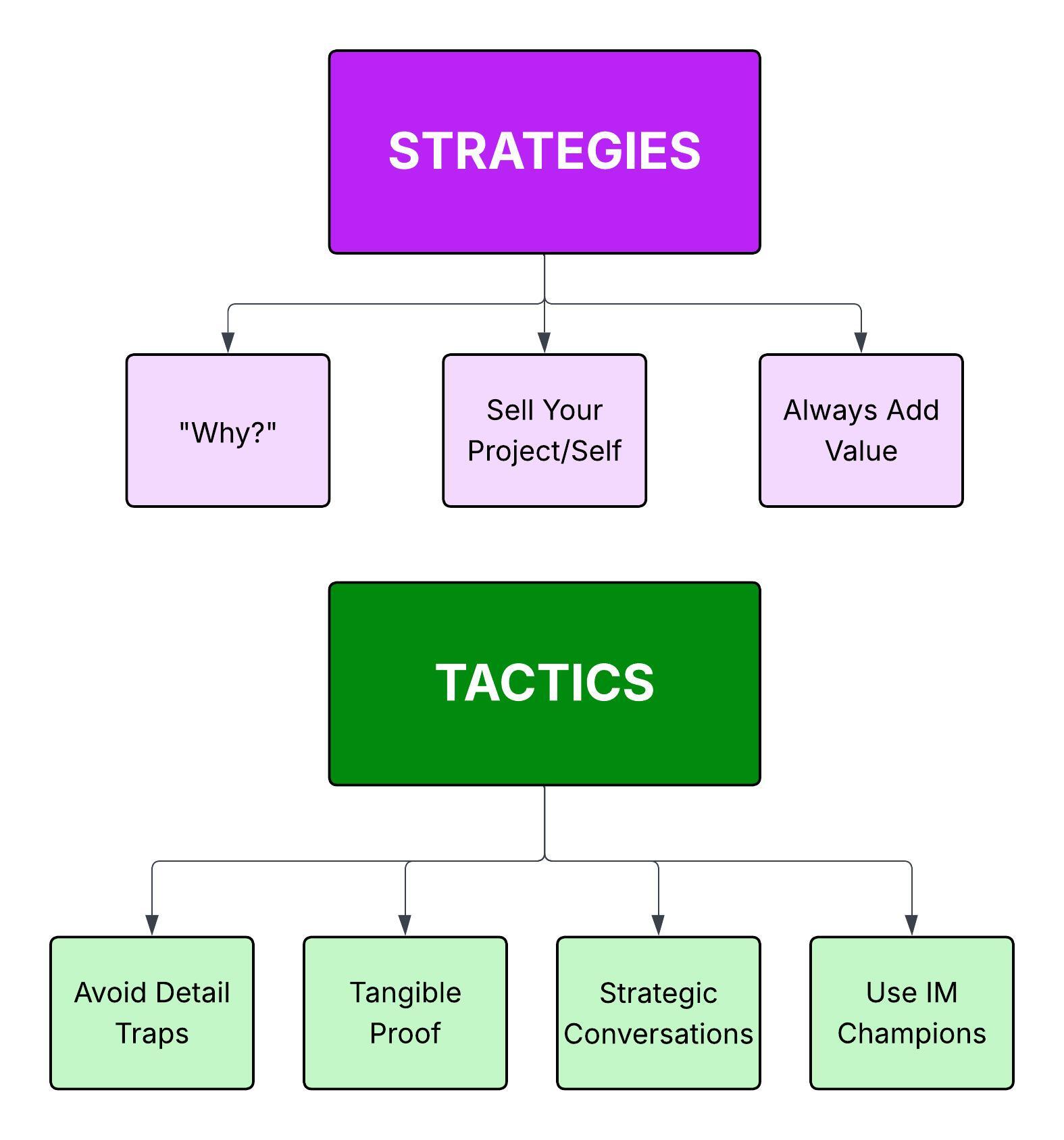
We just went over strategy in some detail, but what about the tactics we can put into motion? First, let’s differentiate between the two terms:
Strategy is the battle plan and how we allocate resources: where you’re aiming; which digital hills to conquer; how IM supports the grand campaign instead of acting as a fire brigade running from crisis to crisis. We plan beforehand, gather the requisite resources and make our decisions based on the information we have.
Tactics incorporate the troops on the ground and how resources are used up: the work of tagging the records; applying sentencing decisions; cleaning up the folders of Jan who retired after 27 years and never named anything correctly. These are the actions of getting the actual job done before the enemy, also known as the shared drive, takes over our lives.
First tactic: Avoid Detail Traps
Executives don’t care about a beautifully crafted ontology or the ins and outs of a Sharepoint tagging system. They care about what it fixes, what it costs, and whether it is worth doing. If you lead with technical detail, you will quickly sound like someone who should be talking to a manager a few layers down, not the people holding the purse strings. That’s the Detail Trap. Talk outcomes first and only get into the detail if specifically asked for.
- Q: “Ok, but how do I do it differently?”
A: Be concise, outcome‑first, and decision‑oriented: lead with the one sentence that answers the section above: “Why are we doing this?” Tailor language to outcomes and KPIs (if any), and use a one‑slide executive summary. Know what drives your executives and what gaps they want to close. Finish up with a clear decision and next step.
Second Tactic: Provide tangible proof you/your project are worth investing in
“We’re good value because we benchmarked ourselves against others” is a good start, but it is not a silver bullet in of itself. You need to show the numbers in a way that makes it obvious where the money is going now, and what changes if your project goes ahead. What does the current setup actually cost when you factor in staff time? Do storage levels and costs decrease? Can we de-duplicate by implementing this? What about any delays? Or the quiet inefficiencies no one tracks properly? Then stack that up against alternatives like outsourcing, or doing nothing and letting the problem grow from a hill into a mountain (FYI – it’s ok to have a “complete disaster” scenario lined up. It happens!)
From there, make the comparison hard to ignore. If bringing work in-house saves money, show how the project does this. If outsourcing is more expensive but reduces risk or speeds things up, be upfront about the trade-off. Even rough figures are better than hand-waving, as long as the logic is sound and easy to follow. The goal is to make it painfully clear, with the information at hand, that the current state has a cost, and your option is a better use of funds.
- Q: “Great. How do I start quantifying?”
A: Add up your current total cost of ownership, benchmark it against outsourcing quotes, model two or three in‑house improvement scenarios with conservative ROI and payback time, then present the single recommended option and a clear ask to approve a pilot.
Third Tactic: Start Having Strategic Conversations
IM conversations can end up as feature parades straight from the SaaS providers business catalogue (ie. “This could have been an email with links…”) where eyes glaze over and people start checking the exits. Execs are not there for a deep dive on business classification systems, they are there to understand trade-offs, risks, and what decision needs to be made, and at what cost. If you are not clearly putting a decision and multiple potential solutions on the table, the conversation can end up drifting. The last thing we want is for your project to be parked up in an unlabelled box in the back of the store room, never to see the light of day again (until you archive it as part of your R&D BAU…).

The shift is simple but may be uncomfortable when adopting and practicing it. Start framing discussions around outcomes, what could go wrong, and the options in front of your leaders. A great way to do this, with buy in from your Executive Sponsor, is to form an IM or Digital Steering Group where strategic questions can be raised with other organisation leaders and actions points written down. Until you bring others into the fold, IM faces the reality of staying in the back office quietly doing its thing while decisions are made elsewhere.
- Q: “And the answer is?”
A: As per above, form an IM or Digital Steering Group. Another great process to undertake is an IM Maturity Assessment. Put the findings in bold, rank priorities and make hard decisions about where resources need to go first and foremost to make the biggest impact. These conversations and findings can also end up guiding your IM Strategy.
Fourth Tactic: Identify potential IM Champions and give them tools to succeed
Newsflash: Not every executive is going to care about IM!
And that’s really ok. The smarter move is to find individuals within your organisation who already feel the pain, have a bit of IM experience and want to make their lives, and the lives of those around them, easier. Maybe they’ve dealt with an audit finding, a messy OIA/LGOIMA request, or a project that went sideways because no one could find the right information seven folders deep in Sharepoint. Those are your potential IM champions. They don’t need to be or become IM experts, they just need to see clearly how better information practices make their world easier.
Once you’ve found them, give your IM Champions something useful to work with. Keep it simple and practical:
- Get them to show people in their department how IM solves their problems, not yours
- Give them before/after examples they can relate to and reuse
- Encourage them to tweak the IM message for their department and language
- Back them with enough substance so they don’t get caught out
- Support and encourage them if things go pear-shaped or tricky, technical questions enter the equation.
When our IM Champions own the message it carries more weight than anything coming from just the IM team.
- Q: “Sounds great, but how do I get them started?”
A: We want to empower and encourage our IM Champions, not brief them. If they have to translate your work every time they talk about it, they won’t bother. Make the overall message simple and easy to repeat. Back it up with concrete evidence they can use and show others. Do not pressure them to do the selling for you – if you work collaboratively, the others will do the lifting for you.
THE FUTURE FOR IM/EXEC NATIVE SPEAKERS
The future of Information Management will not be defined by how well we manage records in isolation, but by how effectively we connect information practices to organisational direction. While our organisations are required to shift to keep pace with the current environment, we also need to shift our thoughts and practices as IM professionals. This includes managing records as a technical function to shaping the conditions for more reliable decision-making. In that environment, IM is no longer a support service sitting on the sidelines; it then grows into a part of how organisations operate and manage.
Alongside this shift is the emergence of a new core capability: the IM translator. The professionals who will succeed are those who can move fluently between operational detail and executive priorities, articulating value in terms that are native to decision-makers. Not everyone needs to become a strategist, but everyone needs to be able to explain in clear and practical terms why information matters, and the value we can add to it.
The future of IM will not belong to the loudest technical expert in the room, but the professional who can turn complexity into clarity, and, in turn, clarity into action
If you’ve made it this far, thank you for reading. Please feel free to leave a comment below and start a conversation, or get in contact with me to help win over your exec for your IM project!